About this Blog

RYT-200 trained in Rishikesh, India.
Born and raised in Oklahoma, USA.
India travel, yoga philosophy, Sanskrit language, and more.
Showing posts with label Hatha yoga. Show all posts

Thursday, October 2, 2014

Sanskrit Friday: Pigeon (कपोत) + An Announcement

Happy Sanskrit Friday!

I'm happy to announce I'm hosting a tw-hour workshop on the Sounds of Sanskrit on Saturday, October 12th from 2-4pm at Be Love Studio in Tulsa, Oklahoma! I'm really excited.


In this 2-hour workshop we will demystify the pronunciation, sounds, and meanings of Sanskrit words to enhance and deepen your practice. No knowledge of Sanskrit is necessary. Just bring yourself. Thank you, hope to see you there.
https://www.facebook.com/events/534148846715574/
Sanskrit Workshop at Be Love
-----


Today's word is कपोत. It's pronounced kuh-poht-ah-sun and means pigeon in English.


 -----Pronunciation----- Listen and hear the Sanskrit pronunciation below.


You see the word used in combination with असन (asana, or pose) to make कपोतासन, kapotasana or pigeon pose. Sometimes this pose is called one footed king pigeon, or king pigeon. It's all the same pose, perhaps done to varying degrees. The full form is as shown  below, but the most common expression we see is without bending the leg and reaching for it. Here are the other variations with a breakdown of the Sanskrit:
  • कपोतासन kapotasana = kapota + asana = "pigeon pose"
  • एक पाद राजकपोतासन  eka pada rajakapotasana = eka + pada + raja + kapota + asana = "one foot king pigeon pose"
  • राजकपोतासन rajakapotasana = "king pigeon pose"
Eka-Pada-Raja-Kapotasana Yoga-Asana Nina-Mel
The "full" expression of pigeon pose
    Sanskrit is the universal language of yoga and connects us all together. Thanks for reading. You've got another Sanskrit word under your belt! For tips on learning how to read and write in Sanskrit in its native script, read my post here.

    Until next week. नमस्ते,

    Tyler

    Friday, September 26, 2014

    Sanskrit Friday: Hand (हस्त)

    Happy Sanskrit Friday!

    Today is the next installment of the "Anatomy Sanskrit" series! We will be learning both animals and anatomy words over the next couple months.


    Today's word is हस्त. It's pronounced huhst or huh-stuh in English and means hand. In the States you sometimes hear it as hah-stuh.

     -----Pronunciation----- Listen and hear the Sanskrit pronunciation below.


    You see the word used in combination with असन (asana, or pose) AND another word to make a pose name. Strangely handstands in yoga practice aren't called "hastasana" but actually downward facing tree (adho mukha vrksasana). Here are several pose names you may have heard in class:
    • उत्थित हसत पादाङ्गुष्ठसन utthita hasta padangusthasana = "standing hand to big toe pose"
    • सुपत हसत पादाङ्गुष्ठसन supta hasta padangusthasana = "reclined hand to big toe pose"
    • पादहस्तासन padahastasana = "foot to hand pose" 
    • ऊर्ध्व हस्तासन urdhva hastasana = "raised arms pose"  

    Sanskrit is the universal language of yoga and connects us all together. It's like music.

    Thanks for reading. You've got another Sanskrit word under your belt! For tips on learning how to read and write in Sanskrit in its native script, read my post here.


    Thank you! Until next week. नमस्ते,

    Tyler

    Friday, September 19, 2014

    Sanskrit Friday: Eagle (गरुड)

    Hello, and happy Sanskrit Friday!
     

    My apologies for not posting last week. I taught a few volunteer classes and ended up traveling a whole lot on Thursday and Friday. We will continue to learn animal and anatomy words over the next few months!


    Today's word is गरुड. It's pronounced like "guh-rood" and best translates to eagle in English. While writing this post I discovered that the eagle most closely associated with garuda is the brahminy kite, native to the Indian subcontinent. You can read more about the mythical bird Garuda here.

     -----Pronunciation----- Listen and hear the Sanskrit pronunciation below.


    You see the word used in combination with असन (asana, or pose)  to make garudasana, Eagle Pose. Guh-roo-dahsana. This is a great balancing pose and good for cyclists. It's one of the few poses that works adduction of the hip joints, which feels really nice if you've been sitting all day. Wikipedia has a photo up to show you how it looks:

    Garuḍāsana - Eagle Pose 2 in side view


    Thanks for reading. You've got another Sanskrit word under your belt! For tips on learning how to read and write in Sanskrit in its native script, read my post here.

    Thank you! Until next week.

    नमस्ते,

    Tyler

    Friday, September 5, 2014

    Sanskrit Friday: Big Toe (पादाङ्गुष्ठ)

    Hello, and happy Sanskrit Friday!

    I've been hard at work designing a new infographic for the start of today's "Anatomy Sanskrit" series! We will be learning animals and anatomy words over the next few months.


    Today's word is पादाङ्गुष्ठ. It's pronounced pahd-ung-goosht in English and means big toe. Angustha means thumb, so your foot's thumb is...your big toe

     -----Pronunciation-----The first syllable can be pronounced "puhd" or "pahd" (पाद) because both words in Sanskrit mean foot. A common "misspelling" of this word is padangushtasana. That's because there's a "sh" sound in the word, and the Sanskrit "th" sound isn't like the one in English. Listen and hear the Sanskrit pronunciation below.


    You see the word used in combination with असन (asana, or pose) AND another word to make a pose name. Here are several you may have heard in class:
    • उत्थित हसत पादाङ्गुष्ठसन utthita hasta padangusthasana = "standing hand to big toe pose"
    • सुपत हसत पादाङ्गुष्ठसन supta hasta padangusthasana = "reclined hand to big toe pose"
    Thanks for reading. You've got another Sanskrit word under your belt! For tips on learning how to read and write in Sanskrit in its native script, read my post here.

    Thank you! Until next week.

    नमस्ते,

    Tyler

    Friday, August 29, 2014

    Sanskrit Friday: Scorpion (वृश्चिक)

    Today's word is वृश्चिक. It's pronounced vrush-chick in English and means scorpion.

    You see the word used in combination with असन (asana, or pose) to make वृश्चिकासन vrschikasana, or scorpion pose. We spell it like "vrs" but it's pronounced like "vrush."

    Isn't the Sanskrit writing beautiful?

    The "r" sound in this word is considered a vowel in Sanskrit. Crazy, right? In linguistics terms, the sound is a syllabic r
    and is an allophone of our r sound. Say it with me – vrschikasana. Vrschikasana!
     

    Vrschikasana is an advanced arm balance backbend pose and requires a lot of core and shoulder strength. It's very challenging! There's an excellent journal article for Scorpion Pose on Yoga Journal. My advice is to try feathered peacock (pincha mayurasana) first and then work into Scorpion using the wall.

    Thanks for reading. You've got another Sanskrit word under your belt! For tips on learning how to read and write in Sanskrit in its native script, read my post here.

    Thank you! Until next week.

    नमस्ते,

    Tyler

    Friday, August 22, 2014

    Sanskrit Friday: Tittibha/Lapwing (टिट्टिभ)

    Hi! Happy Sanskrit Friday!


    Today's word is टिट्टिभ. It's pronounced tih-ttih-bhuh in English and means lapwing or tittibha bird, which is a kind of bird that lives on the coast in India.

    You see the word used in combination with असन (asana, or pose) to make टिट्टिभासन tittibhasana, which in English we've come to refer to as firefly pose. As far as I can tell, there is no Sanskrit basis for the translation of tittibha to mean firefly. If anyone has any information on why this has come to be, please comment below!


    The "t" sound in tittibha is made in the middle-upper part of the mouth. In linguistics terms, the sound is a voiceless retroflex stop and, to me, is one of those sounds that sounds distinctly Indian. The double "tt" is held a bit longer than just one t, as though there is a pause there. Say it with me – tittibhasana. Tittibhasana!

    Tittibhasana is an intermediate/advanced arm balance pose and requires a lot of core and shoulder strength. It's best done after malasana (garland pose) and बकासन bakasana (crane/crow pose). You can also transition from tittibhasana back into bakasana while still balancing on your arms. It's very challenging!


    Thanks for reading. You've got another Sanskrit word under your belt! For tips on learning how to read and write in Sanskrit in its native script, read my post here.

    Thank you! Until next week.

    नमस्ते,

    Tyler

    Friday, August 15, 2014

    Sanskrit Friday: Camel (उष्ट्र)

    Hi! Happy Sanskrit Friday!


    Today's word is उष्ट्र. It's pronounced euh-shtra in English and means camel, but it also means buffalo. Hmm! You see this word used in combination with असन (asana, or pose) to make उष्ट्रासन ustrasana, or camel pose.

    There are two "sh" sounds in sanskrit. The "sh" sound here is like an English "sh" sound but made more in the back of the mouth.
    Say it with me now — ustrasana. Ustrasana
    !

    Ustrasana
    is a moderately difficult pose and requires much attention to form. A good camel pose involves lengthening the spine up and back and not pushing your hips and glutes forward. Focus on making the spine very long, the chest very open. Place your fists into your lower back and lean up and back from there. When you're ready you can reach for your ankles behind you. You can also keep your head in line with the spine rather than dropping the head back.


    Thanks for reading. You've got another Sanskrit word under your belt! For tips on learning how to read and write in Sanskrit in its native script, read my post here.

    Thank you! Until next week.

    नमस्ते,

    Tyler

    Friday, August 8, 2014

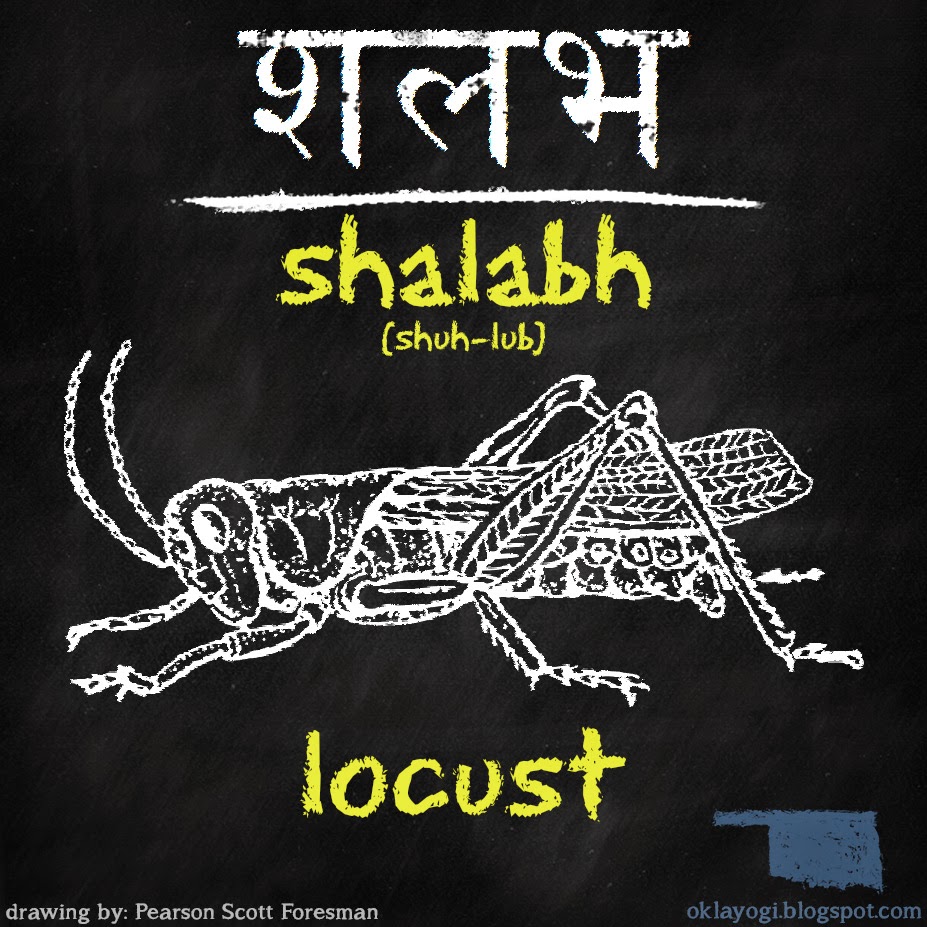
    Sanskrit Friday: Locust (शलभ)


    Hello! Happy Sanskrit Friday!


    Today's word is शलभ. It's pronounced shuh-lub in English and means locust. You see this word used in combination with असन (asana, or pose) to make शलभासन shalabhasana, or locust pose. The "bh" sound is like a regular "b" sound but you breathe out more while you speak. Say it with me now — shalabhasana. Shalabhasana!

    शलभ (shalabh) means locust, but it also means cricket, grasshopper, and moth. It's as confusing as the word is in English, where it can also mean cicada or grasshopper. I've taken the usage for grasshopper, since the word usage to mean cicada didn't start until the last two hundred years. There's a great explanation on Wikipedia about its etymology if you're interested.


    Shalabhasana
    is a difficult pose, as its a strong back bend using your arms. A good tip is to place your hands palm-up underneath you, using your fingers to prop up your thighs to come deeper into the pose.


    Thanks for reading. You've got another Sanskrit word under your belt! For tips on learning how to read and write in Sanskrit in its native script, read my post here.

    Thank you! Until next week.

    नमस्ते,

    Tyler

    Correction 8/11/14: The pronunciation guide in the infographic has been fixed!

    Sunday, March 30, 2014

    Graduation Ceremony

    We had our graduation ceremony on our last Saturday night. It lasted 3.5 hours, but oh, the dancing! A frenzy of spinning, clapping, and sweating in our kurtas and saris. One of our instructors, Himanshu, and his friends got into the dance circle and danced like fiends! It was such an energy and excitement! I have a video compilation to show you some of our dancing.


    I've had fun times with nearly every one of the fifty students in our training at Rishikesh Yog Peeth. This has been the best group to be with because everyone has been so accepting and loving. It's like nothing I've had before. Lots of beautiful happiness.

    Roshan, our philosopher and anatomy instructor, reads out the names of us graduating.

    The 49th class of 200hr Yoga Teachers at Rishikesh Yog Peeth!
    Me looking very happy! :-D

    I want to leave you with this poem my friend Kelsey Quinn wrote. She recited it at the talent show we had a week before graduation and it sums up my experience in such a vivid way. Many thanks to her for allowing me to publish it here.


    Rishikesh Rememberings
    by Kelsey Quinn

    Slate grey wings dance in the dust overhead. Fluttering, cooing and wrestling in mounds of fluffy feathers resembling the aftermath of a child's pillow fight.

    Thunderous footsteps lumber across steel shelters. Little menacing monkeys with coral cheeks snatch students' snacks.

    Their calm cousins with coal faces covered in silver coats sit quietly in tree tops like wise grandparents who have seen it all and now watch the world with experienced eyes.

    Soothing sounds of sitar and singing bowls spiral up the streets. Diffused smells of smokey nag champa and finger-warming fires mingle with the grounding scents of overflowing sacs of cardamom, fresh butter cookies and seasonal strawberries secured to cycles.

    Cows express sporadic moos
    Bikes bellow perpetual horns

    Yuhhh! yells the man pushing his cart containing cruciferous crops. I can't help but wonder…is this perhaps the hindi word for cauliflower?
    Tonight we are serving rice, lentils, and yuhhh!

    In the hall Happy says Smile, Deepa says 'Yes? Yes, class?' Roshan says 'Pardon Pardon Pardon?', Dipti giggles.

    Frying pumpkin fritters waft from Krishna's Kitchen. It's meatball night! Yogis rejoice in the spandex nature of their clothing. 
    Grating, chopping, clanging and blending…blending, blending…mmmmmmm…margaritas…No. No. Back to the breath.

    Blue kites soaring on rooftops amuse the young all morning. Rapturous cricket in deserted courtyards keeps the boys 'til evening.
    Tangerine robes drape over spindly brown shins. Still sitting, smoke spiraling.

    Brown cows, black cows, white cows.
    White dogs, black dogs, brown dogs. 

    Rose petals, marigold garlands, rust brick piles.
    Mahogany mala beads, orange bindis, crimson bracelets, white rice;

    Aquamarine ganga, turquoise gems, ruby rings, emerald foothills.
    Green carpet, green heart chakra
    Heart overflows

    -----

    I'll continue to publish my adventures in Rishikesh, and about Holi festival, and about my week-long travel in Rajasthan (camelback safari!) so stay tuned. Thanks so much.


    Tyler

    Friday, February 21, 2014

    My Daily Life in Rishikesh, India

    Hello, everyone!

    We're nearing the end of week 3 of training and I haven't updated at all! Today that changes. Today I will let know you know what I've been up.

    So as you may know, I'm taking a 200-hour Yoga Teacher Training course at Rishikesh Yog Peeth in northern India. Rishikesh is in the northern state of India called Uttarakhand. It's considered the "world capital of yoga" and also the "gateway to the Himalayas" according to popular sources.

    That red dot there? That's Rishikesh.
    Rishikesh Yog Peeth is on the south side of the river. I'm a 5 minute walk from the Ganges river, which on a sunny day is quite beautiful and blue. I like to study on the rocks by the river. In Hindi the river is known as Ganga [gun-guh].
    The beautiful Ganges river. I went whitewater rafting in it!


    Rishikesh Yog Peeth - Main area (Krishna Cottage)

    My Yoga Schedule

    Our daily routine is the same Monday-Friday. It consists of the following:

    5:30am – Wake Up

    This is easy enough. I've became quite used to waking up early and like it. I usually get up around 6am. We're trained to not use our alarm clocks, but I use mine just in case.

    My room. Queen-size bed, two blankets, and a nice bathroom.

    It's often windy and ominous in the morning before sunrise.

    6:30am – Tea and Jala Neti (nasal cleansing)

    It's brisk in the morning and we're up before the sun. Grab a hot ayurvedic tea at the cafeteria to warm your hands and stomach, then it's off to do jala neti. We each have a little plastic neti pot and pour a small amount of saline solution through each nostril to clean our sinuses. I'm usually congested in the mornings but it helps clear them. I've come to really enjoy jala neti practice.

    Nasal cleansing...approved.

    7-9am – Morning asana (yoga) practice

    Two hours of yoga. Usually this involves mantra chanting in the beginning and some hands-on work on individual poses and how to make adjustments in them. You don't notice your hunger too much, surprisingly.

    Yoga Hall 1 - the main hall. All of my practices and classes are here.

    9:30am – Breakfast

    Glorious breakfast. Our entire diet here is satvic and vegetarian. We usually have fruit and chickpeas for breakfast. Sometimes it's a rice mix, or noodles, or porridge which is really delicious. Breakfast is always wonderful.

    This is also the time to do your laundry. I really enjoy washing my own clothes - provides a good 15-minutes to relax my mind and an excuse to visit the rooftop.

    Me and my laundry. Yes, those are my pants.
    This is also the time the Rhesus monkeys are most active. They will push on doors or find an open one and steal food out of your room. They are quite greedy, these monkeys.


    I've been almost attacked three times now because they were eating on the staircase to the rooftop. I keep a small supply of "monkey diversion" bananas in my room if this happens now.


    10:30-1pm –  Anatomy and/or Philosophy class

    Roshan, our main instructor, teaches us about the physiology of yoga and its relationship to the body and also to yoga philosophy. There is a LOT of philosophy behind yoga that doesn't get explained in the West except on a very surface level.

    It's amazing how much there is to learn. Learning anatomy has been quite fun, too, and the scientist nerd in me is excited to learn about Bohr effect and other things in class.


    1:30pm – Lunch

    Delicious lunchtime! Many people sit in the courtyard and take their meal in the sunlight. It's quite nice. Lunch usually consists of rice, steamed and fresh vegetables, and a soup with daal (lentils) or beans of some kind.


    2-4:15pm – Self-Study Time

    This is our own time for personal growth. I usually study Sanskrit at the nearby cafe, but I'm also taking tabla lessons a few times each week. It's a beautiful time to be out and about.

    An awesome cafe right by our place. Great vibe and cheap tea.

    4:30-6:30pm – Afternoon asana (yoga) practice

    Afternoon practice is usually more intense than morning, but lately both have been physically and mentally challenging. We usually begin and end in Shavasana (corpose pose) but the first two weeks we ended with 20 minutes of seated meditation practice. It's quite challenging but rewarding.


    6:45pm – Dinner

    We're usually pretty hungry for dinner after asana practice. Dinner is pretty variable but always has chapatti, which is like the Indian version of tortilla. One dining is designated for silence. I've eaten dinner in silence twice and enjoyed the experience to really focus on my mind and food. Talking is nice, though, too. There are a lot of interesting and eclectic people here.

    Tea, chapatti, chickpeas, and a delicious porridge dessert with coconut pieces, almonds, and cashews.

    9:30pm – Sleep time

    I'm usually out by 9:30pm. Some nights I'm out by 8:30pm. In the time before I shower, journal about my day, and play my kalimba sometimes. I'm a morning person so going to bed early has been a nice habit to get back into.

    So...that's my daily activity! I'm learning a lot about yoga poses and the science and philosophy of yoga. The 40+ other trainees here are fantastic and I'm very grateful to have such an open-minded, friendly, and responsible group

    I'll update about my weekend trips soon. Namaste, and talk to you later!


    Tyler