About this Blog

RYT-200 trained in Rishikesh, India.
Born and raised in Oklahoma, USA.
India travel, yoga philosophy, Sanskrit language, and more.
Showing posts with label india. Show all posts

Thursday, October 2, 2014

Sanskrit Friday: Pigeon (कपोत) + An Announcement

Happy Sanskrit Friday!

I'm happy to announce I'm hosting a tw-hour workshop on the Sounds of Sanskrit on Saturday, October 12th from 2-4pm at Be Love Studio in Tulsa, Oklahoma! I'm really excited.


In this 2-hour workshop we will demystify the pronunciation, sounds, and meanings of Sanskrit words to enhance and deepen your practice. No knowledge of Sanskrit is necessary. Just bring yourself. Thank you, hope to see you there.
https://www.facebook.com/events/534148846715574/
Sanskrit Workshop at Be Love
-----


Today's word is कपोत. It's pronounced kuh-poht-ah-sun and means pigeon in English.


 -----Pronunciation----- Listen and hear the Sanskrit pronunciation below.


You see the word used in combination with असन (asana, or pose) to make कपोतासन, kapotasana or pigeon pose. Sometimes this pose is called one footed king pigeon, or king pigeon. It's all the same pose, perhaps done to varying degrees. The full form is as shown  below, but the most common expression we see is without bending the leg and reaching for it. Here are the other variations with a breakdown of the Sanskrit:
  • कपोतासन kapotasana = kapota + asana = "pigeon pose"
  • एक पाद राजकपोतासन  eka pada rajakapotasana = eka + pada + raja + kapota + asana = "one foot king pigeon pose"
  • राजकपोतासन rajakapotasana = "king pigeon pose"
Eka-Pada-Raja-Kapotasana Yoga-Asana Nina-Mel
The "full" expression of pigeon pose
    Sanskrit is the universal language of yoga and connects us all together. Thanks for reading. You've got another Sanskrit word under your belt! For tips on learning how to read and write in Sanskrit in its native script, read my post here.

    Until next week. नमस्ते,

    Tyler

    Friday, September 26, 2014

    Sanskrit Friday: Hand (हस्त)

    Happy Sanskrit Friday!

    Today is the next installment of the "Anatomy Sanskrit" series! We will be learning both animals and anatomy words over the next couple months.


    Today's word is हस्त. It's pronounced huhst or huh-stuh in English and means hand. In the States you sometimes hear it as hah-stuh.

     -----Pronunciation----- Listen and hear the Sanskrit pronunciation below.


    You see the word used in combination with असन (asana, or pose) AND another word to make a pose name. Strangely handstands in yoga practice aren't called "hastasana" but actually downward facing tree (adho mukha vrksasana). Here are several pose names you may have heard in class:
    • उत्थित हसत पादाङ्गुष्ठसन utthita hasta padangusthasana = "standing hand to big toe pose"
    • सुपत हसत पादाङ्गुष्ठसन supta hasta padangusthasana = "reclined hand to big toe pose"
    • पादहस्तासन padahastasana = "foot to hand pose" 
    • ऊर्ध्व हस्तासन urdhva hastasana = "raised arms pose"  

    Sanskrit is the universal language of yoga and connects us all together. It's like music.

    Thanks for reading. You've got another Sanskrit word under your belt! For tips on learning how to read and write in Sanskrit in its native script, read my post here.


    Thank you! Until next week. नमस्ते,

    Tyler

    Friday, September 19, 2014

    Sanskrit Friday: Eagle (गरुड)

    Hello, and happy Sanskrit Friday!
     

    My apologies for not posting last week. I taught a few volunteer classes and ended up traveling a whole lot on Thursday and Friday. We will continue to learn animal and anatomy words over the next few months!


    Today's word is गरुड. It's pronounced like "guh-rood" and best translates to eagle in English. While writing this post I discovered that the eagle most closely associated with garuda is the brahminy kite, native to the Indian subcontinent. You can read more about the mythical bird Garuda here.

     -----Pronunciation----- Listen and hear the Sanskrit pronunciation below.


    You see the word used in combination with असन (asana, or pose)  to make garudasana, Eagle Pose. Guh-roo-dahsana. This is a great balancing pose and good for cyclists. It's one of the few poses that works adduction of the hip joints, which feels really nice if you've been sitting all day. Wikipedia has a photo up to show you how it looks:

    Garuḍāsana - Eagle Pose 2 in side view


    Thanks for reading. You've got another Sanskrit word under your belt! For tips on learning how to read and write in Sanskrit in its native script, read my post here.

    Thank you! Until next week.

    नमस्ते,

    Tyler

    Friday, September 5, 2014

    Sanskrit Friday: Big Toe (पादाङ्गुष्ठ)

    Hello, and happy Sanskrit Friday!

    I've been hard at work designing a new infographic for the start of today's "Anatomy Sanskrit" series! We will be learning animals and anatomy words over the next few months.


    Today's word is पादाङ्गुष्ठ. It's pronounced pahd-ung-goosht in English and means big toe. Angustha means thumb, so your foot's thumb is...your big toe

     -----Pronunciation-----The first syllable can be pronounced "puhd" or "pahd" (पाद) because both words in Sanskrit mean foot. A common "misspelling" of this word is padangushtasana. That's because there's a "sh" sound in the word, and the Sanskrit "th" sound isn't like the one in English. Listen and hear the Sanskrit pronunciation below.


    You see the word used in combination with असन (asana, or pose) AND another word to make a pose name. Here are several you may have heard in class:
    • उत्थित हसत पादाङ्गुष्ठसन utthita hasta padangusthasana = "standing hand to big toe pose"
    • सुपत हसत पादाङ्गुष्ठसन supta hasta padangusthasana = "reclined hand to big toe pose"
    Thanks for reading. You've got another Sanskrit word under your belt! For tips on learning how to read and write in Sanskrit in its native script, read my post here.

    Thank you! Until next week.

    नमस्ते,

    Tyler

    Friday, August 29, 2014

    Sanskrit Friday: Scorpion (वृश्चिक)

    Today's word is वृश्चिक. It's pronounced vrush-chick in English and means scorpion.

    You see the word used in combination with असन (asana, or pose) to make वृश्चिकासन vrschikasana, or scorpion pose. We spell it like "vrs" but it's pronounced like "vrush."

    Isn't the Sanskrit writing beautiful?

    The "r" sound in this word is considered a vowel in Sanskrit. Crazy, right? In linguistics terms, the sound is a syllabic r
    and is an allophone of our r sound. Say it with me – vrschikasana. Vrschikasana!
     

    Vrschikasana is an advanced arm balance backbend pose and requires a lot of core and shoulder strength. It's very challenging! There's an excellent journal article for Scorpion Pose on Yoga Journal. My advice is to try feathered peacock (pincha mayurasana) first and then work into Scorpion using the wall.

    Thanks for reading. You've got another Sanskrit word under your belt! For tips on learning how to read and write in Sanskrit in its native script, read my post here.

    Thank you! Until next week.

    नमस्ते,

    Tyler

    Friday, August 22, 2014

    Sanskrit Friday: Tittibha/Lapwing (टिट्टिभ)

    Hi! Happy Sanskrit Friday!


    Today's word is टिट्टिभ. It's pronounced tih-ttih-bhuh in English and means lapwing or tittibha bird, which is a kind of bird that lives on the coast in India.

    You see the word used in combination with असन (asana, or pose) to make टिट्टिभासन tittibhasana, which in English we've come to refer to as firefly pose. As far as I can tell, there is no Sanskrit basis for the translation of tittibha to mean firefly. If anyone has any information on why this has come to be, please comment below!


    The "t" sound in tittibha is made in the middle-upper part of the mouth. In linguistics terms, the sound is a voiceless retroflex stop and, to me, is one of those sounds that sounds distinctly Indian. The double "tt" is held a bit longer than just one t, as though there is a pause there. Say it with me – tittibhasana. Tittibhasana!

    Tittibhasana is an intermediate/advanced arm balance pose and requires a lot of core and shoulder strength. It's best done after malasana (garland pose) and बकासन bakasana (crane/crow pose). You can also transition from tittibhasana back into bakasana while still balancing on your arms. It's very challenging!


    Thanks for reading. You've got another Sanskrit word under your belt! For tips on learning how to read and write in Sanskrit in its native script, read my post here.

    Thank you! Until next week.

    नमस्ते,

    Tyler

    Friday, August 15, 2014

    Sanskrit Friday: Camel (उष्ट्र)

    Hi! Happy Sanskrit Friday!


    Today's word is उष्ट्र. It's pronounced euh-shtra in English and means camel, but it also means buffalo. Hmm! You see this word used in combination with असन (asana, or pose) to make उष्ट्रासन ustrasana, or camel pose.

    There are two "sh" sounds in sanskrit. The "sh" sound here is like an English "sh" sound but made more in the back of the mouth.
    Say it with me now — ustrasana. Ustrasana
    !

    Ustrasana
    is a moderately difficult pose and requires much attention to form. A good camel pose involves lengthening the spine up and back and not pushing your hips and glutes forward. Focus on making the spine very long, the chest very open. Place your fists into your lower back and lean up and back from there. When you're ready you can reach for your ankles behind you. You can also keep your head in line with the spine rather than dropping the head back.


    Thanks for reading. You've got another Sanskrit word under your belt! For tips on learning how to read and write in Sanskrit in its native script, read my post here.

    Thank you! Until next week.

    नमस्ते,

    Tyler

    Friday, August 8, 2014

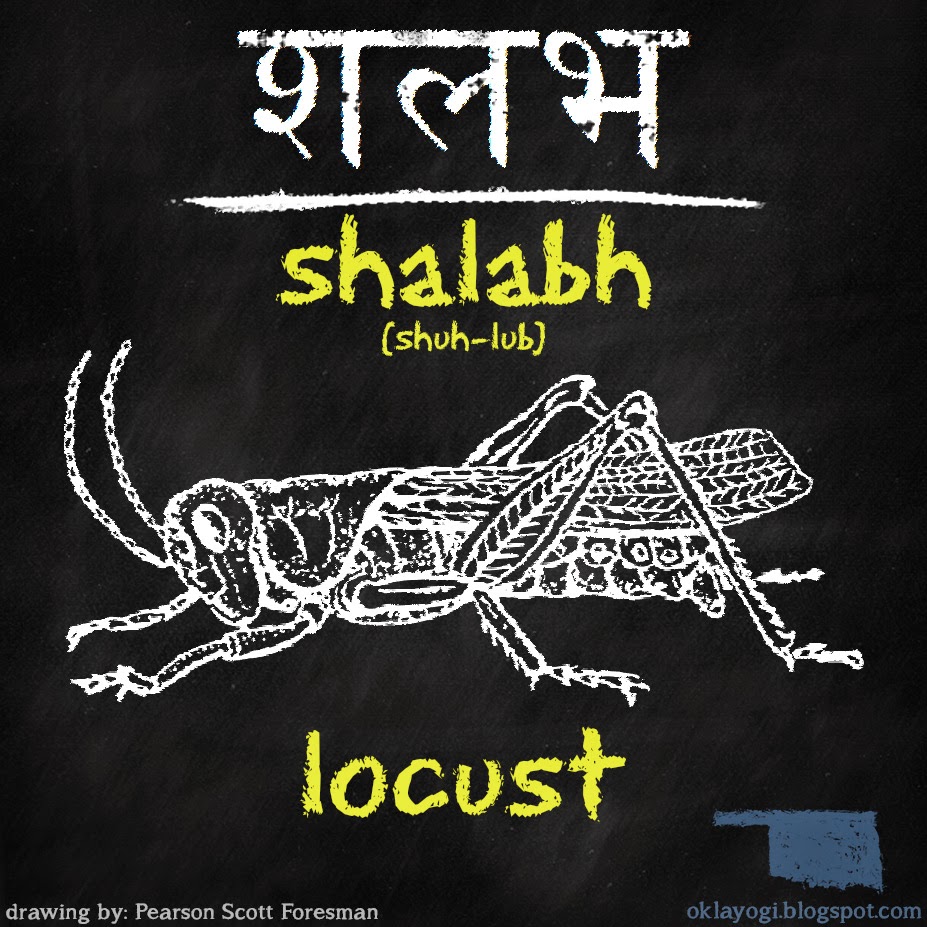
    Sanskrit Friday: Locust (शलभ)


    Hello! Happy Sanskrit Friday!


    Today's word is शलभ. It's pronounced shuh-lub in English and means locust. You see this word used in combination with असन (asana, or pose) to make शलभासन shalabhasana, or locust pose. The "bh" sound is like a regular "b" sound but you breathe out more while you speak. Say it with me now — shalabhasana. Shalabhasana!

    शलभ (shalabh) means locust, but it also means cricket, grasshopper, and moth. It's as confusing as the word is in English, where it can also mean cicada or grasshopper. I've taken the usage for grasshopper, since the word usage to mean cicada didn't start until the last two hundred years. There's a great explanation on Wikipedia about its etymology if you're interested.


    Shalabhasana
    is a difficult pose, as its a strong back bend using your arms. A good tip is to place your hands palm-up underneath you, using your fingers to prop up your thighs to come deeper into the pose.


    Thanks for reading. You've got another Sanskrit word under your belt! For tips on learning how to read and write in Sanskrit in its native script, read my post here.

    Thank you! Until next week.

    नमस्ते,

    Tyler

    Correction 8/11/14: The pronunciation guide in the infographic has been fixed!

    Sunday, August 3, 2014

    Sanskrit Friday-ish: Fish (मत्स्य)

    Hey everyone!

    Sorry for the delay in posting. I've been moving house this weekend and it's taken quite a bit of time!


    Today's word is मत्स्य. It's pronounced muts-yuh in English and means fish. You see this word used in combination with असन (asana, or pose) to make मत्स्यासन matsyasana, or fish pose.

    Say it with me now — matsyasana. Matsyasana
    !

    Matsyasana is a great counter-pose to shoulder stance and plough poses, as it extends your spine in the opposite direction. It's important to keep your chest open wide in this position to help extend your spine. I really enjoy looking at the world upside-down in this pose, viewing the world as a child might.


    Thanks for reading. You've got another Sanskrit word under your belt! For tips on learning how to read and write in Sanskrit in its native script, read my post here.

    Thank you! Until next week.

    नमस्ते,

    Tyler

    Friday, July 25, 2014

    Sanskrit Friday: Cobra (भुजङ्ग)

    Namaste, friends!


    Today's word is भुजङ्ग. It's pronounced bhu-juhn-guh in English and means cobra! You see this word used in combination with असन (asana, or pose) to make भुजङ्गासन, or cobra pose. Say it with me now — bhu-juhn-ga-suhn-uh. Bhu-juhn-ga-suhn-uh!
    I prefer this pose to upward dog because it keeps your lumbar spine supple and supported. Cobra pose has your pelvic bones in contact with the mat, feet touching the mat behind you, either supported 20% through the arms or without. The erector spinae muscles are hard at work and this pose is great for those with forward-leaning shoulders and a closed chest. It's sister pose (to me) is snake pose, which I'll come to in a later post.


    You've got another Sanskrit word under your belt! For tips on learning how to read and write in Sanskrit in its native script, read my post here.

    Thank you! Until next week.

    नमस्ते,

    Tyler

    Friday, July 18, 2014

    Sanskrit Friday: Crane (बक)

    Namaste, friends!


    Today's word is बक. It's pronounced like the word "buck" in English and means crane! You see this word used in combination with असन (asana, or pose) to make बकासन, or crane pose. You'll often hear this pose called crow pose as well, which can also be correct (though the Sanskrit would be  काकासन (kahk-ahsun)). Some schools of yoga make a difference between having your arms bent (crow) and straight (crane) in this arm balance pose.

    A nice tip for beginners is to place a block a few feet in front of you before coming into the pose. This will allow you to gently place the crown of your head on the block to help make crane/crow pose easier.


    You've got another Sanskrit word under your belt! For tips on learning how to read and write in Sanskrit in its native script, read my post here.

    Thank you! Until next week.

    नमस्ते,

    Tyler

    Friday, July 11, 2014

    Sanskrit Friday: Tiger (व्याघ्र)

    Namaste, friends!

    I've moved to Tulsa, OK and teach yoga very regularly here now, so now that I'm kinda established I wanted to bring you my new weekly feature: Sanskrit Friday!

    Today's word is व्याघ्र. It's pronounced vyāghra (vyah-ghruh) and means tiger! You see this word used in combination with असन (asana, or pose) to make व्याघ्रासन, or tiger pose. Total Yoga has a nice explanation of Tiger Pose, although I would recommend keeping your toes pulled back instead of pointing but either is fine.

    You've got one Sanskrit word under your belt! For tips on learning how to read and write in Sanskrit in its native script, read my post here.

    Thank you! Until next week.


    Tyler

    Monday, April 7, 2014

    Monkeys, Cows, Dogs, and More: Living in India

    I was only in India for 7 weeks, but I learned so much about life in India even in that time.

    There's a lot to talk about, so I'll start with a little video compilation I took in Rishikesh to give you an idea of the sights and sounds you'll encounter.


    Life in India is very noisy and visceral. You're surrounded by many people. Rishikesh felt like a small town after Delhi but even it has a population of over 100,000. Towns are build very compact, with brick buildings pushed together and reaching sometimes four stories into the air. It makes for a noisy and open place to live. And your roof is like your backyard and patio. Kids play tag and fly kites up there, men and women hang up their laundry up there, and monkeys hang out up there.

    This is probably unique to living right by the Himalayas, but Rhesus macaques regularly prowl the rooftops in search of good eats. They especially love to take sacks of garbage and rip them open to look for oranges and bananas. Our yoga hall was regularly invaded by these cute but greedy guys.  The trick is to carry a big stick (or a broomstick) and walk toward them menacingly. They show a big game but they'll run.


    The good monkeys are the silver-furred ones. We called them the "yogic" monkeys because they always seemed gentle and at-peace. Never greedy or hot-tempered. And so anthropomorphic.


    Outside in the streets you'll see all manner of animals. Walk down the street and you'll see wild dogs who are somehow well-fed and friendly. They help you fight monkeys, too. Cows litter the streets and do as they place, though shopkeepers won't hesitate to beat them back from their storefronts with a swift pat or push. Or by attacking them with a lawn chair, which I saw once. Luckily cows don't feel a whole lot. I've seen one get pelted by rainwater from a gutter and not budge an inch. Strange beasts, these Brahmin cattle!


    Keep walking and you'll inevitably see poo. And pee. And poo. And more poo. India doesn't smell nearly as bad as I thought it would, but you definitely have a visceral connection with the more, hmm, mundane aspects of living. You get used to it quite easily and it becomes just another part of life.

    You'll also see men playing cricket out in big dirt fields. They'll play cricket anywhere! You can tell this country, by and large, loves to watch and play cricket. The shopowner down the street was always watching it on his little 90's era TV at his shop.


    Something that will affect you each and every time though is the poverty. It's hard not to feel sympathy every time you pass someone holding out their hands for money or food. People often congregate near busy walkways or tourist areas, and you'll pass by a dozen or so at a time sometimes, each one in need. I always gave to this man with atrophied legs. He always had a smile on his face when you passed by and didn't really beg for money, so much as be present with a little tin can and a smile. Even in that situation he can find some happiness, which means I should have nothing to want for. I can walk with both of my legs, see with two eyes, play piano with two hands and arms. There's much to be thankful for. I saw many young people working on roads, building, laying bricks, etc. People work hard in this country.


    Getting around India is easy and cheap. The easiest way is to flag down a tuk-tuk driver. Always haggle with them because they'll often halve the price after a few rounds of "nope, see ya." There's a video a friend of mine shared that explains Tuk-Tuks and their lives pretty darn well.

    https://www.youtube.com/watch?v=c3nAQWxQric

    You can forget about department and grocery stores. I loved visiting the essence oils shop to buy my soap and incense, and then walk to the general store to buy penny candies, toilet paper, and chocolate bars. Toilet paper is a luxury in India and a single roll will set you back 25-30 rupees (50¢). Men come by with carts full of cauliflower, tomatoes, and beet carrots for sale. It's a very traditional and lovely way to buy your goods. They also have stands by the sides of the roads.


    I lived by the ganges and was very fortunate to be so upstream to see its waters clear and blue. People bathe regularly in the Ganges, pray to it, and make offerings by sending plates of marigolds and such downstream. Little children come by wanting to sell you flowers for 5-10 rupees. Lots of children selling flowers and such by the river. I wished they could be kids more and play instead of having to work at such a young age. India has a lot of poverty. It was hard for me to see a middle-class while I was there. Everyone's trying to get by, help their families, etc.


    The saddhus are a funny bunch. They wear orange and never cut their hair. I saw a couple of them play fighting with their canes once. I'm not sure if they are enlightened, ascetic and working towards enlightenment, or what, but they're always to be found on the benches by the chai stall, talking and smoking bidi with their pipes.


    Traffic is mad but has a rhythm and a rule to it. Street lights are non-existent outside of major cities. It's so safe because there are no rules - you have to be observant in order not to hit anyone or anything. I spent a day driving with a rented scooter and had no trouble navigating the streets or the highways, though I wish they used parabolic mirrors for those unguarded, don't-run-off-the-cliff-because-ouch hairpin turns. It's fun to see the roads in Indian towns!


    Dining out is cheap and delicious. You can have a lassi, naan, a main dish, AND ice cream or some other treat for 200-300 rupees, which is 4 or 5 USD. It's amazing. Indian food and chai can be had for even less.


    The nights are dark, for there aren't many streetlights in towns like Rishikesh. It's great because you have a great chance to view the stars and planets up in the sky. Right from your rooftop!

    Hope you enjoyed the post. It meandered a bit but let me know if you liked it. :-)


    Tyler

    Saturday, March 8, 2014

    Weekend Trip: Mountain Temple

    Every weekend our yoga school takes us on a field trip. Our first weekend we visited a temple high in the mountains called Jayamataki (जयमाताकी) about 30 minutes northeast of Ram Jhula.

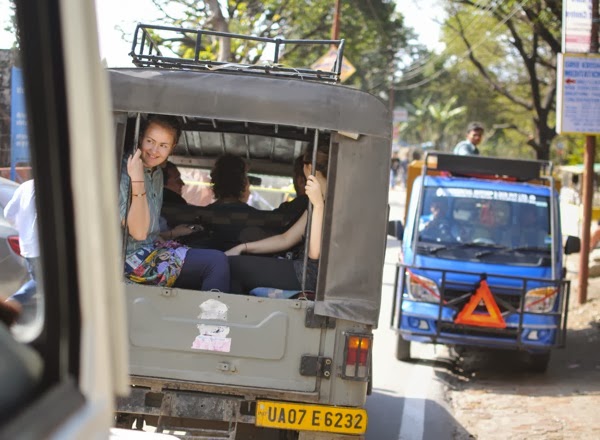
    Getting there was a blast. They fit 6-8 of us into a jeep and drove us through winding roads. It was quite bumpy a bit worrying as we cornered unprotected cliffsides, but we arrived at the temple safely.

    DSC 2785 This is going to be an adventure!

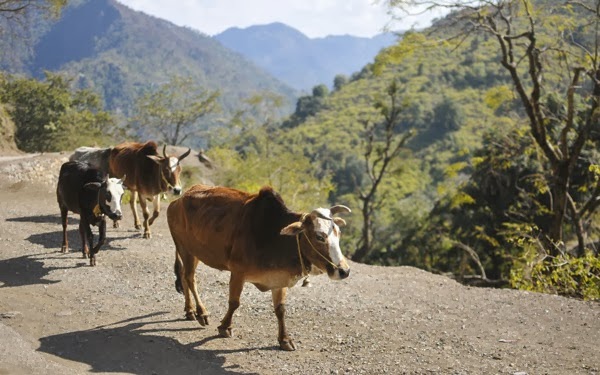
    DSC 2775That look. These cows. India!

    DSC 2645The Temple is up quite a few stairs and a long path! Nice little jog.

    DSC 2650There’s a bell at the start of the stairs and at the finish. You ring both as you start and complete your journey. 
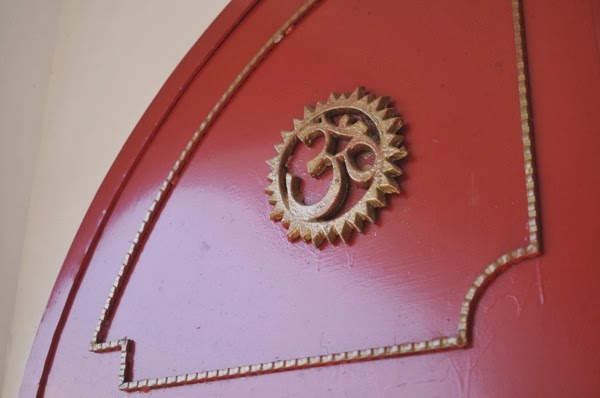
    DSC 2656The inner part of the temple was quite small and simple. There were a few statues for offerings and worship.

    DSC 2653Bells were present throughout this temple.
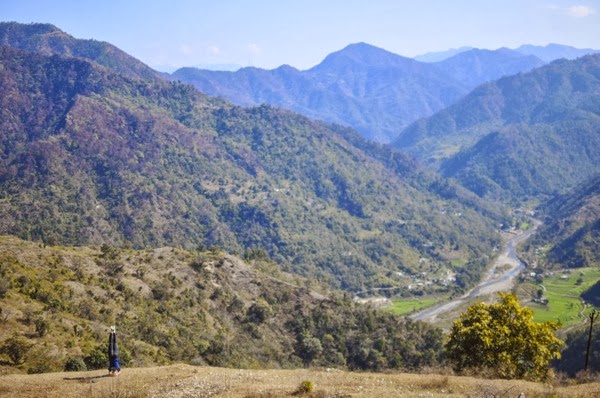
    I wasn’t interested in the temple so much as the view from the mountain. It was stunning. Walking up the hill, it hit me that I was in India and I was moved.

    DSC 2676Me doing a headstand before the valley. Very trippy to see such a view from upside down!
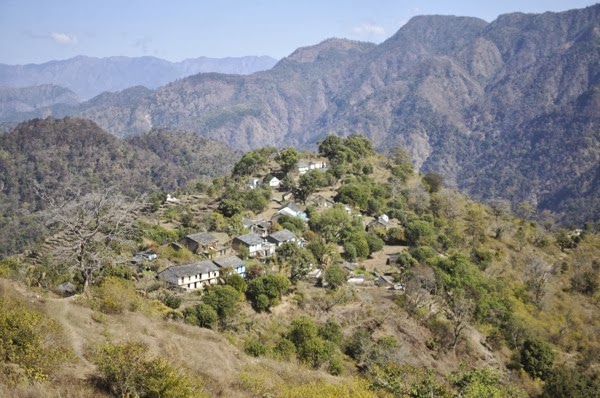
    DSC 2684It was like a page out of National Geographic. Little villages tucked into the foothills of the Himalayas. Wow!

    We had chai and cookies on the front patio area. A lot of us sat by the mountain and contemplated what it meant to be here. Others did some yoga poses and took photos. For each one of us the experience was different and had a different meaning. For me…I was happy to be in nature. After some photos I went by myself down aways and just sat there, enjoying the view.

    MountaintempleEnjoy this 360º I took of the mountainside. It’s a beautiful sight. (Click to view)

    I’ve been really lax about updating because of our studies. It’s my hope to post about each of the weekend trips here over the next few days. Hope you enjoyed the post!


    Tyler

    Tuesday, December 10, 2013

    The India Visa Application - How to Apply via Post

    I haven't found a good, comprehensive guide to mail your application to BLS in Houston, so I wanted to write one and help others along their way.

    My entire process took 13 days from applying to receiving the visa.

    This article pertains to the BLS Houston office and the requirements on their website. The info here may not apply to the office in NY, SF, etc.


    Since Mid-2013 US citizens applying for their visa to India must go through BLS International to do so. BLS doesn't have the best track record, and it made me pretty nervous at first. There's a reason they have those bad reviews - their website contains a lot of redundancy and hidden requirements for your visa application, among other things. The India Visa Application website is labeled a security risk by my browser, Firefox, and I had to make an security exception just to see the webpage!

    But never fear, it is possible. And hopefully in 2014 you won't have to go through this at all thanks to some upcoming changes in visa policy.

    Below are the things you need to send to BLS in order to get your visa. This is compiled from their website and my phone conversation with a representative at BLS Houston. You'll need to send in a trackable envelope:
    1. Your passport (obvious, perhaps, but they don't actually mention this on this website) with at least two blank visa pages
    2. A completed, printed, and signed (twice) version of the Online Visa Application Form
      1. Reading my tips for the form first is recommended.
      2. PASTE a 2" x 2" passport-style photo where indicated on this form. Don't paperclip.
    3. An extra 2" x 2" passport-style photo 
      1. The rep said this was just in case. Clip to the application or your BLS form.
    4. Proof of address
      1. For me this was a scan of the front of my driver's license.
    5. Cashier's check designated to "BLS International"
    6. Photocopy of said cashier's check
    7. Filled and signed Postal Application Form
      1. This is NOT the "Requisite Documents for Tourist Visa" form. You don't need that one for some reason.
    8. Filled BLS form (provided to you after you finish it on their website)
    9. Self-addressed Trackable Envelope (from FedEx or UPS preferably)
      1. This one is folded and goes inside your envelope and is for the return shipment.
    Now here's the thing. You have to get your trackable envelopes BEFORE you fill out the BLS form. They ask for your "air bill" (tracking) numbers for both sending and returning envelopes.  I went to UPS with items 1 through 7 and had them weigh that + with two envelopes and a small stack of blank pages just to make sure it would be properly paid for. I purchased 2nd Day Air for my sending envelope and Next Day Air for my returning one (at a cost of $60). Not taking any chances.

    After that I went back to my house and finished the BLS form using the tracking numbers I purchased. I printed out the "BLS order form" and put it inside the envelope. I went back to UPS, taped the BLS shipping label on the outside of the envelope, and wrote "Visa Department" above it in Sharpie. Then I sent it off and I'm done! I hope...

    UPDATE: I received my visa in 13 days after sending it off. Wonderful!

    Tips for Completing the India Online Visa Application Form

    Long title, but a short post! There are just a few things to think about when filling out this form.

    I filled out the online form three times before having a satisfactory application that I (hope) won't be rejected. Why three times? Well, read my tips below and find out!
    1. Read the sample form and its helpful comments first
    2. Read this guy's helpful article second
    3. Read my tips
    I'm applying on a tourist visa but I'm headed to India for my yoga certification. This is okay to do! Don't lie on your application but do phrase things smart. Don't raise any red flags that might get your request denied.
    • Don't put "Cameraman," journalist, writer, reporter, or anything remotely journalist-y for your occupation on the form. I put fitness instructor (and not yoga teacher) just in case they would be suspicious about my reasons for coming. I was a student once, so I put former occupation as "Student." Don't put unemployed, I've heard.
    • I did NOT put Goa, Mysore, or Rishikesh on my list of places I'd be visiting. No need to raise red flags. I put "Agra" and "Delhi" for me.
    • Put the city AND state where your parents were born. Slipped my mind the first time around.
    • Your reference in India must have, according to BLS, a street and the 6-digit zip/post code specification. Just to be safe I used a hostel in Delhi (that I may or may not stay at) just to play it safe. I had to really search hard to find an actual address for a hostel in Delhi...!
      • Name: Pulkit Katyal
      • Address: Hotel The Spot
        867-868 Pahar Ganj New Delhi 110055
      • Phone: +91-11-23580168
    • If you go back and edit your application be careful as some fields will reset to YES and can wreck your application (you don't have Pakistani grandparents, do you?).
    • Save your application as PDF, keeping and noting the filename. The first twelve characters of it (starting with USA and ending just before AA) constitute your application number.
    • Sign the front page, just below your photograph
    • Sign the back page where indicated
    • PASTE a photograph, don't clip or tape it to the application.
    After that, read my tips on actually applying for your visa with BLS here. I hope that helps, and let me know what worked for you!

    नमस्ते!

    Namaste! नमस्ते!

    Hello, and welcome to my blog!

    My name is Tyler, and I'm going to Yog Peeth ashram in Rishikesh, Uttarakhand, India for my RYT 200 certification in late January for 6-7 weeks.

    I'm really excited and have been preparing since October for my journey.

    Talk to you all later!