About this Blog

RYT-200 trained in Rishikesh, India.
Born and raised in Oklahoma, USA.
India travel, yoga philosophy, Sanskrit language, and more.

Friday, September 19, 2014

Sanskrit Friday: Eagle (गरुड)

Hello, and happy Sanskrit Friday!
 

My apologies for not posting last week. I taught a few volunteer classes and ended up traveling a whole lot on Thursday and Friday. We will continue to learn animal and anatomy words over the next few months!


Today's word is गरुड. It's pronounced like "guh-rood" and best translates to eagle in English. While writing this post I discovered that the eagle most closely associated with garuda is the brahminy kite, native to the Indian subcontinent. You can read more about the mythical bird Garuda here.

 -----Pronunciation----- Listen and hear the Sanskrit pronunciation below.


You see the word used in combination with असन (asana, or pose)  to make garudasana, Eagle Pose. Guh-roo-dahsana. This is a great balancing pose and good for cyclists. It's one of the few poses that works adduction of the hip joints, which feels really nice if you've been sitting all day. Wikipedia has a photo up to show you how it looks:

Garuḍāsana - Eagle Pose 2 in side view


Thanks for reading. You've got another Sanskrit word under your belt! For tips on learning how to read and write in Sanskrit in its native script, read my post here.

Thank you! Until next week.

नमस्ते,

Tyler

Friday, September 5, 2014

Sanskrit Friday: Big Toe (पादाङ्गुष्ठ)

Hello, and happy Sanskrit Friday!

I've been hard at work designing a new infographic for the start of today's "Anatomy Sanskrit" series! We will be learning animals and anatomy words over the next few months.


Today's word is पादाङ्गुष्ठ. It's pronounced pahd-ung-goosht in English and means big toe. Angustha means thumb, so your foot's thumb is...your big toe

 -----Pronunciation-----The first syllable can be pronounced "puhd" or "pahd" (पाद) because both words in Sanskrit mean foot. A common "misspelling" of this word is padangushtasana. That's because there's a "sh" sound in the word, and the Sanskrit "th" sound isn't like the one in English. Listen and hear the Sanskrit pronunciation below.


You see the word used in combination with असन (asana, or pose) AND another word to make a pose name. Here are several you may have heard in class:
  • उत्थित हसत पादाङ्गुष्ठसन utthita hasta padangusthasana = "standing hand to big toe pose"
  • सुपत हसत पादाङ्गुष्ठसन supta hasta padangusthasana = "reclined hand to big toe pose"
Thanks for reading. You've got another Sanskrit word under your belt! For tips on learning how to read and write in Sanskrit in its native script, read my post here.

Thank you! Until next week.

नमस्ते,

Tyler

Friday, August 29, 2014

Sanskrit Friday: Scorpion (वृश्चिक)

Today's word is वृश्चिक. It's pronounced vrush-chick in English and means scorpion.

You see the word used in combination with असन (asana, or pose) to make वृश्चिकासन vrschikasana, or scorpion pose. We spell it like "vrs" but it's pronounced like "vrush."

Isn't the Sanskrit writing beautiful?

The "r" sound in this word is considered a vowel in Sanskrit. Crazy, right? In linguistics terms, the sound is a syllabic r
and is an allophone of our r sound. Say it with me – vrschikasana. Vrschikasana!
 

Vrschikasana is an advanced arm balance backbend pose and requires a lot of core and shoulder strength. It's very challenging! There's an excellent journal article for Scorpion Pose on Yoga Journal. My advice is to try feathered peacock (pincha mayurasana) first and then work into Scorpion using the wall.

Thanks for reading. You've got another Sanskrit word under your belt! For tips on learning how to read and write in Sanskrit in its native script, read my post here.

Thank you! Until next week.

नमस्ते,

Tyler

Friday, August 22, 2014

Sanskrit Friday: Tittibha/Lapwing (टिट्टिभ)

Hi! Happy Sanskrit Friday!


Today's word is टिट्टिभ. It's pronounced tih-ttih-bhuh in English and means lapwing or tittibha bird, which is a kind of bird that lives on the coast in India.

You see the word used in combination with असन (asana, or pose) to make टिट्टिभासन tittibhasana, which in English we've come to refer to as firefly pose. As far as I can tell, there is no Sanskrit basis for the translation of tittibha to mean firefly. If anyone has any information on why this has come to be, please comment below!


The "t" sound in tittibha is made in the middle-upper part of the mouth. In linguistics terms, the sound is a voiceless retroflex stop and, to me, is one of those sounds that sounds distinctly Indian. The double "tt" is held a bit longer than just one t, as though there is a pause there. Say it with me – tittibhasana. Tittibhasana!

Tittibhasana is an intermediate/advanced arm balance pose and requires a lot of core and shoulder strength. It's best done after malasana (garland pose) and बकासन bakasana (crane/crow pose). You can also transition from tittibhasana back into bakasana while still balancing on your arms. It's very challenging!


Thanks for reading. You've got another Sanskrit word under your belt! For tips on learning how to read and write in Sanskrit in its native script, read my post here.

Thank you! Until next week.

नमस्ते,

Tyler

Friday, August 15, 2014

Sanskrit Friday: Camel (उष्ट्र)

Hi! Happy Sanskrit Friday!


Today's word is उष्ट्र. It's pronounced euh-shtra in English and means camel, but it also means buffalo. Hmm! You see this word used in combination with असन (asana, or pose) to make उष्ट्रासन ustrasana, or camel pose.

There are two "sh" sounds in sanskrit. The "sh" sound here is like an English "sh" sound but made more in the back of the mouth.
Say it with me now — ustrasana. Ustrasana
!

Ustrasana
is a moderately difficult pose and requires much attention to form. A good camel pose involves lengthening the spine up and back and not pushing your hips and glutes forward. Focus on making the spine very long, the chest very open. Place your fists into your lower back and lean up and back from there. When you're ready you can reach for your ankles behind you. You can also keep your head in line with the spine rather than dropping the head back.


Thanks for reading. You've got another Sanskrit word under your belt! For tips on learning how to read and write in Sanskrit in its native script, read my post here.

Thank you! Until next week.

नमस्ते,

Tyler

Friday, August 8, 2014

Sanskrit Friday: Locust (शलभ)


Hello! Happy Sanskrit Friday!


Today's word is शलभ. It's pronounced shuh-lub in English and means locust. You see this word used in combination with असन (asana, or pose) to make शलभासन shalabhasana, or locust pose. The "bh" sound is like a regular "b" sound but you breathe out more while you speak. Say it with me now — shalabhasana. Shalabhasana!

शलभ (shalabh) means locust, but it also means cricket, grasshopper, and moth. It's as confusing as the word is in English, where it can also mean cicada or grasshopper. I've taken the usage for grasshopper, since the word usage to mean cicada didn't start until the last two hundred years. There's a great explanation on Wikipedia about its etymology if you're interested.


Shalabhasana
is a difficult pose, as its a strong back bend using your arms. A good tip is to place your hands palm-up underneath you, using your fingers to prop up your thighs to come deeper into the pose.


Thanks for reading. You've got another Sanskrit word under your belt! For tips on learning how to read and write in Sanskrit in its native script, read my post here.

Thank you! Until next week.

नमस्ते,

Tyler
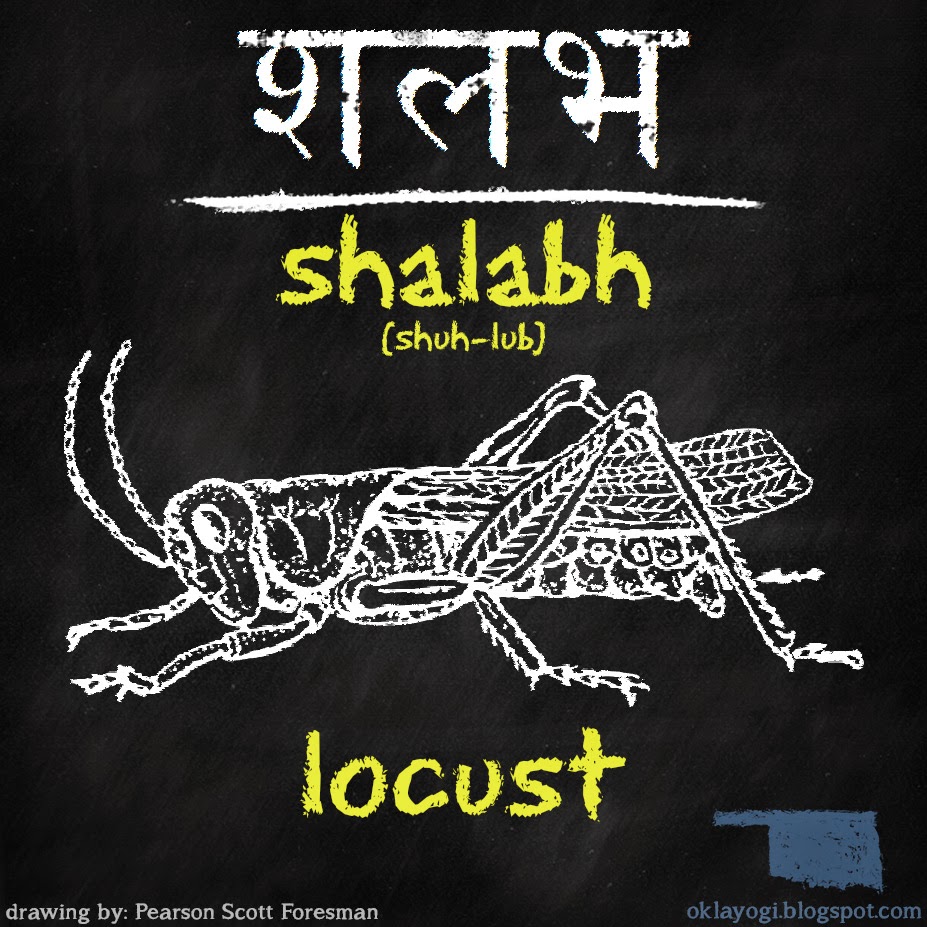
Correction 8/11/14: The pronunciation guide in the infographic has been fixed!

Sunday, August 3, 2014

Sanskrit Friday-ish: Fish (मत्स्य)

Hey everyone!

Sorry for the delay in posting. I've been moving house this weekend and it's taken quite a bit of time!


Today's word is मत्स्य. It's pronounced muts-yuh in English and means fish. You see this word used in combination with असन (asana, or pose) to make मत्स्यासन matsyasana, or fish pose.

Say it with me now — matsyasana. Matsyasana
!

Matsyasana is a great counter-pose to shoulder stance and plough poses, as it extends your spine in the opposite direction. It's important to keep your chest open wide in this position to help extend your spine. I really enjoy looking at the world upside-down in this pose, viewing the world as a child might.


Thanks for reading. You've got another Sanskrit word under your belt! For tips on learning how to read and write in Sanskrit in its native script, read my post here.

Thank you! Until next week.

नमस्ते,

Tyler