About this Blog

RYT-200 trained in Rishikesh, India.
Born and raised in Oklahoma, USA.
India travel, yoga philosophy, Sanskrit language, and more.

Friday, August 15, 2014

Sanskrit Friday: Camel (उष्ट्र)

Hi! Happy Sanskrit Friday!


Today's word is उष्ट्र. It's pronounced euh-shtra in English and means camel, but it also means buffalo. Hmm! You see this word used in combination with असन (asana, or pose) to make उष्ट्रासन ustrasana, or camel pose.

There are two "sh" sounds in sanskrit. The "sh" sound here is like an English "sh" sound but made more in the back of the mouth.
Say it with me now — ustrasana. Ustrasana
!

Ustrasana
is a moderately difficult pose and requires much attention to form. A good camel pose involves lengthening the spine up and back and not pushing your hips and glutes forward. Focus on making the spine very long, the chest very open. Place your fists into your lower back and lean up and back from there. When you're ready you can reach for your ankles behind you. You can also keep your head in line with the spine rather than dropping the head back.


Thanks for reading. You've got another Sanskrit word under your belt! For tips on learning how to read and write in Sanskrit in its native script, read my post here.

Thank you! Until next week.

नमस्ते,

Tyler

Friday, August 8, 2014

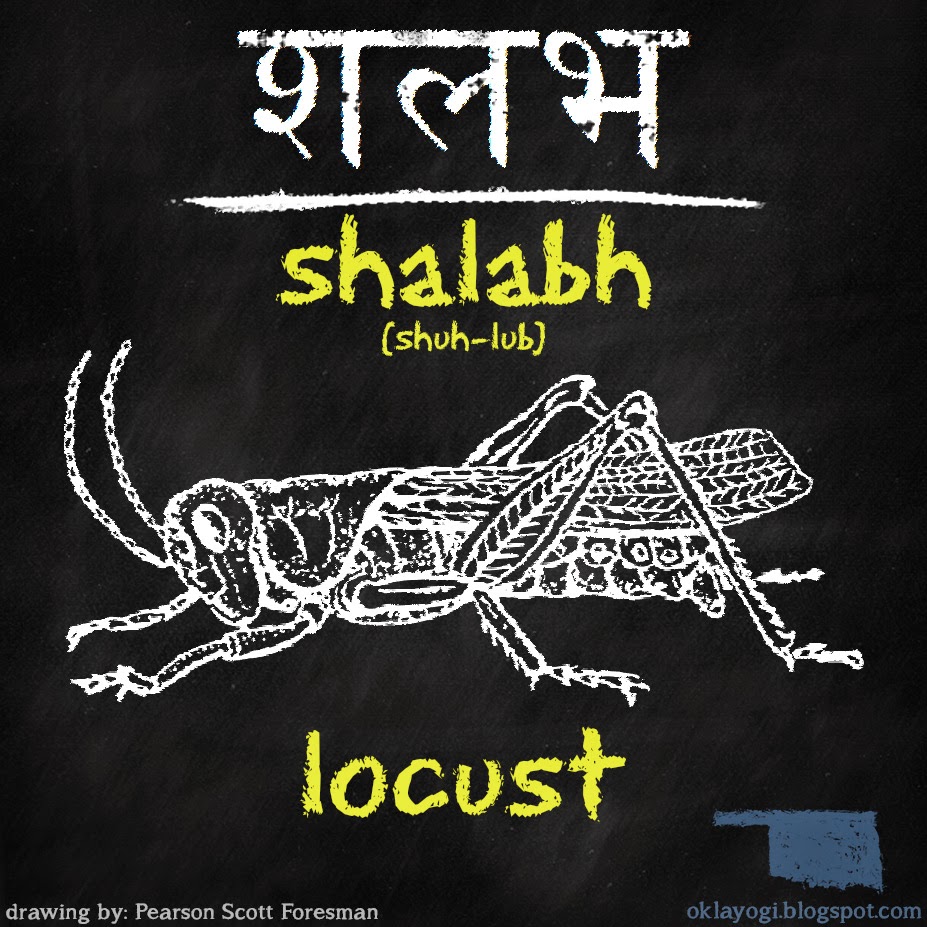
Sanskrit Friday: Locust (शलभ)


Hello! Happy Sanskrit Friday!


Today's word is शलभ. It's pronounced shuh-lub in English and means locust. You see this word used in combination with असन (asana, or pose) to make शलभासन shalabhasana, or locust pose. The "bh" sound is like a regular "b" sound but you breathe out more while you speak. Say it with me now — shalabhasana. Shalabhasana!

शलभ (shalabh) means locust, but it also means cricket, grasshopper, and moth. It's as confusing as the word is in English, where it can also mean cicada or grasshopper. I've taken the usage for grasshopper, since the word usage to mean cicada didn't start until the last two hundred years. There's a great explanation on Wikipedia about its etymology if you're interested.


Shalabhasana
is a difficult pose, as its a strong back bend using your arms. A good tip is to place your hands palm-up underneath you, using your fingers to prop up your thighs to come deeper into the pose.


Thanks for reading. You've got another Sanskrit word under your belt! For tips on learning how to read and write in Sanskrit in its native script, read my post here.

Thank you! Until next week.

नमस्ते,

Tyler

Correction 8/11/14: The pronunciation guide in the infographic has been fixed!

Sunday, August 3, 2014

Sanskrit Friday-ish: Fish (मत्स्य)

Hey everyone!

Sorry for the delay in posting. I've been moving house this weekend and it's taken quite a bit of time!


Today's word is मत्स्य. It's pronounced muts-yuh in English and means fish. You see this word used in combination with असन (asana, or pose) to make मत्स्यासन matsyasana, or fish pose.

Say it with me now — matsyasana. Matsyasana
!

Matsyasana is a great counter-pose to shoulder stance and plough poses, as it extends your spine in the opposite direction. It's important to keep your chest open wide in this position to help extend your spine. I really enjoy looking at the world upside-down in this pose, viewing the world as a child might.


Thanks for reading. You've got another Sanskrit word under your belt! For tips on learning how to read and write in Sanskrit in its native script, read my post here.

Thank you! Until next week.

नमस्ते,

Tyler

Friday, July 25, 2014

Sanskrit Friday: Cobra (भुजङ्ग)

Namaste, friends!


Today's word is भुजङ्ग. It's pronounced bhu-juhn-guh in English and means cobra! You see this word used in combination with असन (asana, or pose) to make भुजङ्गासन, or cobra pose. Say it with me now — bhu-juhn-ga-suhn-uh. Bhu-juhn-ga-suhn-uh!
I prefer this pose to upward dog because it keeps your lumbar spine supple and supported. Cobra pose has your pelvic bones in contact with the mat, feet touching the mat behind you, either supported 20% through the arms or without. The erector spinae muscles are hard at work and this pose is great for those with forward-leaning shoulders and a closed chest. It's sister pose (to me) is snake pose, which I'll come to in a later post.


You've got another Sanskrit word under your belt! For tips on learning how to read and write in Sanskrit in its native script, read my post here.

Thank you! Until next week.

नमस्ते,

Tyler

Friday, July 18, 2014

Sanskrit Friday: Crane (बक)

Namaste, friends!


Today's word is बक. It's pronounced like the word "buck" in English and means crane! You see this word used in combination with असन (asana, or pose) to make बकासन, or crane pose. You'll often hear this pose called crow pose as well, which can also be correct (though the Sanskrit would be  काकासन (kahk-ahsun)). Some schools of yoga make a difference between having your arms bent (crow) and straight (crane) in this arm balance pose.

A nice tip for beginners is to place a block a few feet in front of you before coming into the pose. This will allow you to gently place the crown of your head on the block to help make crane/crow pose easier.


You've got another Sanskrit word under your belt! For tips on learning how to read and write in Sanskrit in its native script, read my post here.

Thank you! Until next week.

नमस्ते,

Tyler

Friday, July 11, 2014

Sanskrit Friday: Tiger (व्याघ्र)

Namaste, friends!

I've moved to Tulsa, OK and teach yoga very regularly here now, so now that I'm kinda established I wanted to bring you my new weekly feature: Sanskrit Friday!

Today's word is व्याघ्र. It's pronounced vyāghra (vyah-ghruh) and means tiger! You see this word used in combination with असन (asana, or pose) to make व्याघ्रासन, or tiger pose. Total Yoga has a nice explanation of Tiger Pose, although I would recommend keeping your toes pulled back instead of pointing but either is fine.

You've got one Sanskrit word under your belt! For tips on learning how to read and write in Sanskrit in its native script, read my post here.

Thank you! Until next week.


Tyler

Monday, April 7, 2014

Monkeys, Cows, Dogs, and More: Living in India

I was only in India for 7 weeks, but I learned so much about life in India even in that time.

There's a lot to talk about, so I'll start with a little video compilation I took in Rishikesh to give you an idea of the sights and sounds you'll encounter.


Life in India is very noisy and visceral. You're surrounded by many people. Rishikesh felt like a small town after Delhi but even it has a population of over 100,000. Towns are build very compact, with brick buildings pushed together and reaching sometimes four stories into the air. It makes for a noisy and open place to live. And your roof is like your backyard and patio. Kids play tag and fly kites up there, men and women hang up their laundry up there, and monkeys hang out up there.

This is probably unique to living right by the Himalayas, but Rhesus macaques regularly prowl the rooftops in search of good eats. They especially love to take sacks of garbage and rip them open to look for oranges and bananas. Our yoga hall was regularly invaded by these cute but greedy guys.  The trick is to carry a big stick (or a broomstick) and walk toward them menacingly. They show a big game but they'll run.


The good monkeys are the silver-furred ones. We called them the "yogic" monkeys because they always seemed gentle and at-peace. Never greedy or hot-tempered. And so anthropomorphic.


Outside in the streets you'll see all manner of animals. Walk down the street and you'll see wild dogs who are somehow well-fed and friendly. They help you fight monkeys, too. Cows litter the streets and do as they place, though shopkeepers won't hesitate to beat them back from their storefronts with a swift pat or push. Or by attacking them with a lawn chair, which I saw once. Luckily cows don't feel a whole lot. I've seen one get pelted by rainwater from a gutter and not budge an inch. Strange beasts, these Brahmin cattle!


Keep walking and you'll inevitably see poo. And pee. And poo. And more poo. India doesn't smell nearly as bad as I thought it would, but you definitely have a visceral connection with the more, hmm, mundane aspects of living. You get used to it quite easily and it becomes just another part of life.

You'll also see men playing cricket out in big dirt fields. They'll play cricket anywhere! You can tell this country, by and large, loves to watch and play cricket. The shopowner down the street was always watching it on his little 90's era TV at his shop.


Something that will affect you each and every time though is the poverty. It's hard not to feel sympathy every time you pass someone holding out their hands for money or food. People often congregate near busy walkways or tourist areas, and you'll pass by a dozen or so at a time sometimes, each one in need. I always gave to this man with atrophied legs. He always had a smile on his face when you passed by and didn't really beg for money, so much as be present with a little tin can and a smile. Even in that situation he can find some happiness, which means I should have nothing to want for. I can walk with both of my legs, see with two eyes, play piano with two hands and arms. There's much to be thankful for. I saw many young people working on roads, building, laying bricks, etc. People work hard in this country.


Getting around India is easy and cheap. The easiest way is to flag down a tuk-tuk driver. Always haggle with them because they'll often halve the price after a few rounds of "nope, see ya." There's a video a friend of mine shared that explains Tuk-Tuks and their lives pretty darn well.

https://www.youtube.com/watch?v=c3nAQWxQric

You can forget about department and grocery stores. I loved visiting the essence oils shop to buy my soap and incense, and then walk to the general store to buy penny candies, toilet paper, and chocolate bars. Toilet paper is a luxury in India and a single roll will set you back 25-30 rupees (50¢). Men come by with carts full of cauliflower, tomatoes, and beet carrots for sale. It's a very traditional and lovely way to buy your goods. They also have stands by the sides of the roads.


I lived by the ganges and was very fortunate to be so upstream to see its waters clear and blue. People bathe regularly in the Ganges, pray to it, and make offerings by sending plates of marigolds and such downstream. Little children come by wanting to sell you flowers for 5-10 rupees. Lots of children selling flowers and such by the river. I wished they could be kids more and play instead of having to work at such a young age. India has a lot of poverty. It was hard for me to see a middle-class while I was there. Everyone's trying to get by, help their families, etc.


The saddhus are a funny bunch. They wear orange and never cut their hair. I saw a couple of them play fighting with their canes once. I'm not sure if they are enlightened, ascetic and working towards enlightenment, or what, but they're always to be found on the benches by the chai stall, talking and smoking bidi with their pipes.


Traffic is mad but has a rhythm and a rule to it. Street lights are non-existent outside of major cities. It's so safe because there are no rules - you have to be observant in order not to hit anyone or anything. I spent a day driving with a rented scooter and had no trouble navigating the streets or the highways, though I wish they used parabolic mirrors for those unguarded, don't-run-off-the-cliff-because-ouch hairpin turns. It's fun to see the roads in Indian towns!


Dining out is cheap and delicious. You can have a lassi, naan, a main dish, AND ice cream or some other treat for 200-300 rupees, which is 4 or 5 USD. It's amazing. Indian food and chai can be had for even less.


The nights are dark, for there aren't many streetlights in towns like Rishikesh. It's great because you have a great chance to view the stars and planets up in the sky. Right from your rooftop!

Hope you enjoyed the post. It meandered a bit but let me know if you liked it. :-)


Tyler